 SlapMac
Deep dives
Does your MacBook have an accelerometer?
By Tonnoz4 min read
If your MacBook has an M1 Pro, an M1 Max, or any M2 chip or newer, yes. There's a small motion sensor on the logic board that measures acceleration in three directions, many times a second. It's not on Apple's spec sheets and there's no official way for apps to read it, which is why almost nobody knows it's there.
The two models people trip over are the M1 MacBook Air and the 13-inch M1 MacBook Pro. Those don't have one.
Didn't old MacBooks have one too?
They did, for a completely different reason. From the mid-2000s Apple put a Sudden Motion Sensor in its laptops: PowerBooks, iBooks and the Intel MacBooks all had one. It had exactly one job, which was protecting the hard drive. If the laptop started to fall, the sensor noticed and the drive parked its read head before it hit the floor.
That made sense when laptops had spinning disks. Once Apple moved to SSDs there was nothing left to park, and Apple's own note on the Sudden Motion Sensor says Macs with flash storage don't use it.
People found other uses for it almost immediately, of course. In 2006, Erling Ellingsen's SmackBook Pro hack let you switch desktops by smacking the side of your MacBook Pro, and an app called MacSaber played lightsaber sounds when you swung your laptop through the air. Twenty years later we're still hitting laptops to make them do things.
The sensor in Apple silicon MacBooks
The motion sensor in today's MacBooks came back without any announcement. There's no setting for it and nothing in Apple's developer documentation. People found it by digging through the I/O Registry, the list macOS keeps of every piece of hardware it knows about.
It shows up there as a group of devices on something macOS calls the SPU. The people who reverse engineered it identify the part as a Bosch BMI286, the same kind of motion sensor you'd find in a phone. olvvier's apple-silicon-accelerometer worked out how to read it, and taigrr's spank turned that into a command-line tool that plays a sound when you slap your laptop. SlapMac was inspired by spank and rebuilt in Swift as a proper Mac app.
On the M4 Pro MacBook Pro I'm writing this on, the registry also lists sensor report channels named for a gyroscope and a compass, right next to the accelerometer. What a laptop would do with a compass, I have no idea.
Which MacBooks have it?
| MacBook | Accelerometer |
|---|---|
| Intel MacBooks | No. Some had the old Sudden Motion Sensor instead. |
| MacBook Air (M1) | No |
| 13-inch MacBook Pro (M1) | No |
| 14-inch and 16-inch MacBook Pro (M1 Pro, M1 Max) | Yes |
| MacBook Air and MacBook Pro with M2 or newer | Yes |
To check yours, open the Apple menu and choose About This Mac. The chip is listed right under the model name.
There's a neat confirmation of this list from Apple itself. When Apple brought Vehicle Motion Cues to the Mac, its support page said the feature works on Mac laptops except the MacBook Neo, the M1 MacBook Air and the 13-inch M1 MacBook Pro or earlier. A feature that reacts to the car you're sitting in needs a motion sensor, and the M1 models it skips are the same ones that don't have this one.
What can you do with it?
Because there's no official API, every app that uses the accelerometer is doing a bit of detective work. Here's what it's good for so far.
Reacting to slaps. This is what SlapMac does. It reads the sensor about 12.5 times a second and runs five detectors on the signal: a high-pass filter, an STA/LTA ratio, CUSUM, kurtosis and a peak/MAD outlier check. They vote, and only a real slap wins, so typing or putting a mug down doesn't count. The harder you hit, the louder it screams, and the menu bar keeps score.

Noticing that someone picked it up. A locked laptop sitting on a table shouldn't suddenly move. SlapMac's Anti-Theft mode uses exactly that: lock the screen, and any movement sets off a siren and takes a photo of whoever is holding it.
Easing motion sickness. Apple's Vehicle Motion Cues and SlapMac's Motion Cues both put moving dots at the edges of the screen that follow the vehicle you're in, so your eyes get the same news as your inner ear. We wrote a whole guide on using a MacBook in a car or train without feeling sick.
There's a hinge sensor as well
The accelerometer isn't the only undocumented sensor in there. In 2025 Sam Henri Gold showed that recent MacBooks know the exact angle of their lid, down to the degree, and built LidAngleSensor, which makes the lid creak like an old door when you open it slowly. It went viral for obvious reasons.
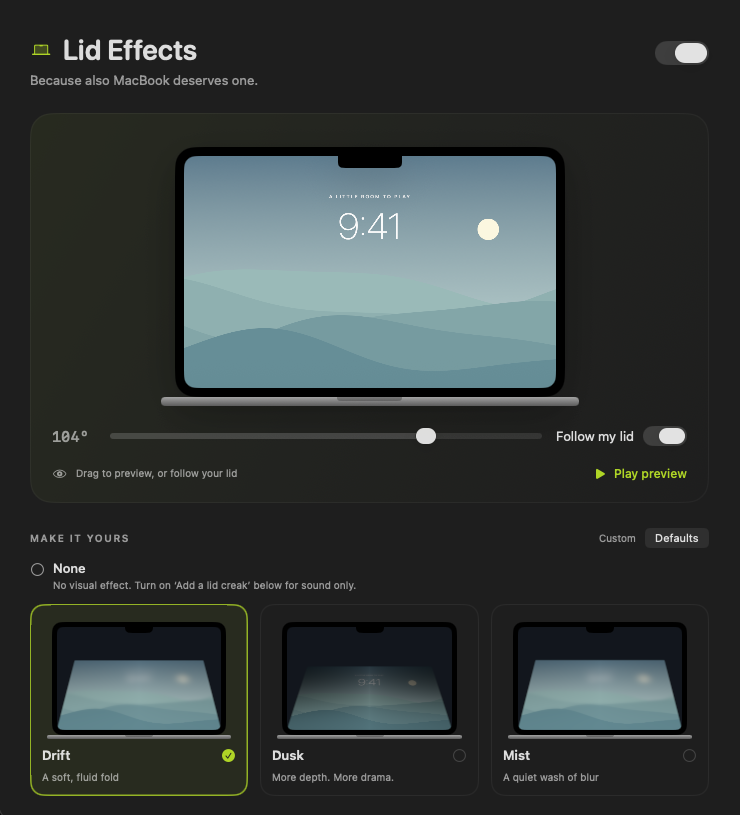
SlapMac uses that sensor for its lid creak sound and for Lid Effects, where your desktop tilts and blurs as the lid comes down.
Does reading it drain the battery?
Not in a way you'll notice. Reading a few numbers a dozen times a second is about the cheapest thing a computer can do, and SlapMac uses less energy than most menu bar apps.
Is it safe to slap your MacBook?
Within reason. The sensor picks up a firm tap on the palm rest perfectly well, so there's no need for a wrestling move. Hit the base, never the screen, and do it with the laptop on a table rather than on your knees.